

Alum of the month: Hoefs living dream as a Yukon helicopter pilot 15 years after leading Griffins to CCAA medal
Jefferson Hagen, MacEwan Athletics
EDMONTON – Perched atop Paint Mountain with some time to kill, Ammon Hoefs fires off a photo of his current view.
The spectacular pano-mode image pings onto the cooped-up city dweller's cellphone on the other end, revealing a breathtaking glimpse of the vast Yukon wilderness.
Hoefs is high above the town of Haines Junction – about 150 kilometres west of Whitehorse – staring at an incredible vista which includes Mt. Martha Black, Kathleen Lake, Dezadeash Lake, the Ibex Valley, and the Dalton and Dezadeash mountain ranges.
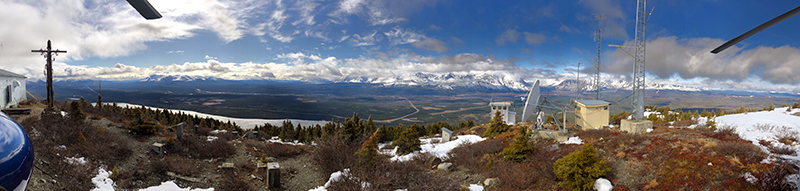
Those are some serious job perks.
As a pilot for Horizon Helicopters, Hoefs is often on top of a mountain, shuttling clients on demand – (on this day, the mission is telecommunications tower maintenance) – to remote areas within flying distance of Whitehorse.
"It's a fun job because it's always different," he explained. "Every morning, you wake up and you think you know how the day's going to go, but in reality, you have no idea, so it's great in that sense. The variety is second to none."
He's now a decade into an adventurous career that includes everything from moving people and supplies to remote camps … to search and rescue and medi-vacs … to flying scientists around for wildlife surveys and fish studies … to heli-skiing and heli-biking.
"There's no sustained industry up here for flying, so everyone is basically a chartered company," he said. "You just wait for the phone to ring and whatever the client needs you do.
"In the summer time, our bread and butter is mining exploration camp support. That's flying geos around, moving drills, flying fuel and core, and groceries and people and supplies, whatever be the case. Forest firefighting, that's a big one. And then there's a lot of environmental work."
In another life, Hoefs was a star forward for the MacEwan men's soccer team, suiting up in Griffins silks for three seasons (2004-07) as a dynamic offensive threat, potting 20 goals in 30 regular season games.
"I distinctly remember my very first goal," he said, happy to reminisce about one of the most prolific careers in the history of the program. "We were either in Red Deer or Calgary. It was a crap shot, I don't even know how it went in. I just remember I half kicked the ground and this thing had a weird wobble, which is why I think it went in because it didn't go where anybody thought it would go."
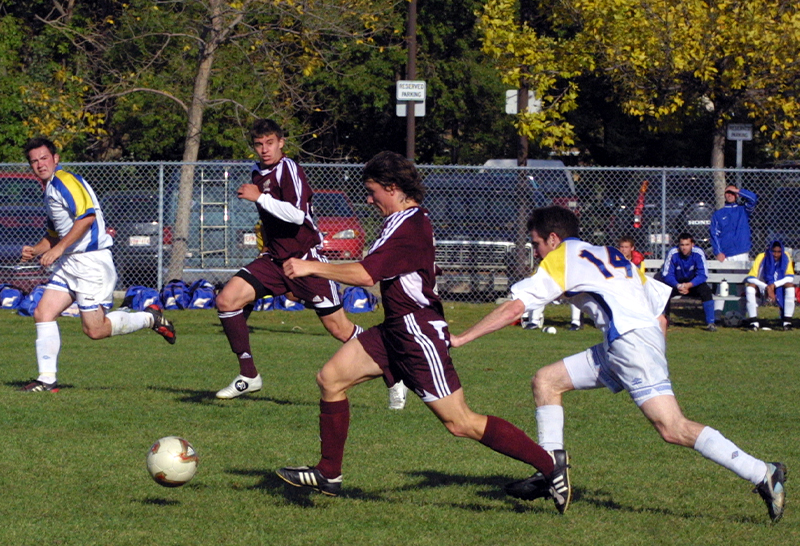 Ammon Hoefs eludes Concordia defenders during a 2005 ACAC game (file photo).
Self-deprecating humour aside, Hoefs was a terrific player, who scored at will more often than not. He once tallied six times in a half against King's College during a 6-0 MacEwan rout in 2006.
"That was actually funny because I scored only (three) more goals the rest of the season," said Hoefs of the Sept. 28, 2006 contest. "It was hilarious. I just couldn't miss that first half.
"That was cool because the second half they had two guys who just followed me everywhere. I literally couldn't do anything. I (almost) scored half my career goals in one half."
Growing up in Whitehorse, soccer was life for Hoefs and his brother Boris – who also played for the Griffins (2005-07) – but to think he'd one day end up as the fourth-leading scorer in Griffins' program history never crossed his mind.
"We were kind of in the first wave of Yukoners to play outside (the territory)," said Ammon Hoefs. "I think before me and my brother there were maybe a half dozen guys who did.
"I think Ash (Jordan) and Ryan (O'Donovan) played a season (each) for Grant MacEwan (2002 and 2001, respectively), but we basically were the first wave of people to open the eyes of everyone in the Yukon – 'I know we're removed and isolated, but it's not as scary as you think it is. We have the talent pool up here to play higher-level soccer.' And that was my goal – to play high-level soccer with my brother. That was a lifelong dream for us.
"We were happy with that. That was an awesome experience and Grant MacEwan was the perfect vessel for that."
When coach Paul Kelly came to Whitehorse prior to the 2004 season, he encouraged Hoefs to come to Edmonton and try out for the Griffins. The rest is a pure success story.
At the end of the 2006-07 season, Hoefs became just the fourth player in men's soccer program history to win MacEwan's Male Athlete of the Year award.
"That completely took me by surprise," he said. "Even when I won the award, I think I was holding the trophy backwards because I was just shell-shocked. It was like 'did someone mess up, was this a joke?' I didn't feel like I deserved it per se, because I always look at my performance and think I could have done more. That was humbling and awesome because 'I guess I'm doing something right.'
"I guess it still hasn't really sunk in because (it's still) surprising, even though it was 15 years ago."
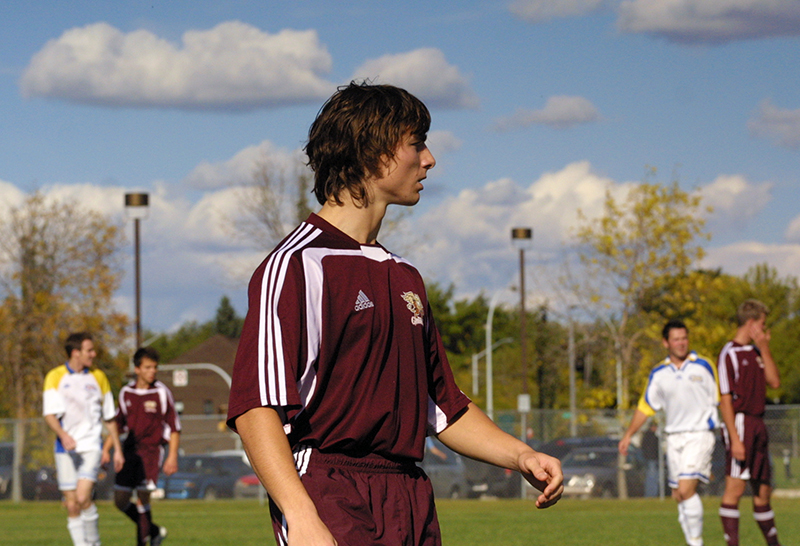 Ammon Hoefs won MacEwan's Male Athlete of the Year award following the 2006-07 season (file photo).
That was the end of a special season for Griffins men's soccer, which produced an ACAC Championship and became the only team in program history to medal at the Canadian Colleges Athletic Association national championship.
As big of an accomplishment as that CCAA bronze medal is now – ("it's one of those things where you don't realize it until after the fact and you reflect months, or even years, later") – Hoefs recalls the players' pinnacle at the time was the fact they finally beat cross-town rival NAIT for the first time in two seasons to win the ACAC title.
The key word is "players" because longtime head coach Murray Orvis knew exactly what landing on the CCAA podium for the first time meant.
"(I remember) just seeing how happy Murray was at the time," said Hoefs. "He knew how special it was. We didn't even really get it. We were just happy that we beat NAIT. 'Oh, yeah, now we're going to nationals.' "
In a victorious frenzy after spiking the Ooks 3-2 to win one of four ACAC banners Griffins men's soccer teams have collected over the years, the key moment isn't hard for Hoefs to recall.
"Matt Cluney scored a ridiculous top corner shot," he said. "Somehow, Matt cranked that frozen ball top corner from just over half. It was an unreal goal. It was on CTV and everywhere else. It was fantastic. We just lost our minds."
Their success was the culmination of a merit-based approach instituted by Orvis, Kelly and their staff where even Hoefs – the team captain – wasn't guaranteed starter's minutes.
"That was a really neat year in terms of team dynamic," he said. "We were all close knit – we had a lot of really good friends – but it was an incredibly competitive environment. No one's position was guaranteed.
"Among the forwards, my brother, Dave Rowse and Matt Cluney were basically rotating almost on a (single) game basis. It was 'perform, or you're benched.' I was the captain of the team and I got benched a couple of games."
What that created was the perfect balance between constructive competitiveness and team unity that sent the Griffins to the national championship in Vancouver seeded third.
"I feel it was a unique balance point – incredibly competitive, but extremely supportive of one another," said Hoefs. "There wasn't back-stabbing, undermining or cliques. We were a unit."
They blanked the Langara Falcons 1-0 in the quarter-finals to set up a date against Ontario powerhouse Algonquin College for a right to play in the national final. Stories of their dominance were already cemented in lore after the Thunder rolled into the nationals unbeaten after outscoring OCAA competition 71-3 in 11 games.
"I think they won one of their league games like 25-1," said Hoefs. "That team had a core group that had been together for like four years, so they were just crushing it.
"The way that it lined up, we met them in the semifinals and they beat us. We didn't have our best game, and they played well, but afterwards we found out they were leery of us."
The Griffins also lost a couple of key players to injury early in the contest and things unraveled from there in a 7-1 defeat.
But MacEwan went on to a comfortable 4-2 win over Capilano College in the bronze match to make program history.
"I know Murray, he was in tears because that was the best MacEwan's ever done," Hoefs recalled. "That's a really cool piece of history that we did our part to help happen. It's pretty special."
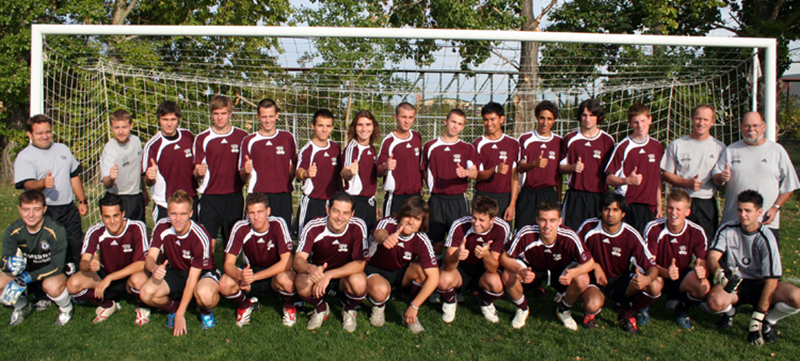 The 2006-07 Griffins men's soccer team is the only squad in program history to medal at nationals, winning bronze at the 2006 CCAA championship (file photo).
Who knows if it would have happened without Hoefs, who almost wasn't with the Griffins in 2006. Intending to transfer to the University of Alberta after compiling enough transfer credits at MacEwan in 2004 and 2005, he was instead the final cut off the Golden Bears' roster.
"They cut me the day before exhibition games where U of A played Grant MacEwan," said Hoefs, who eventually would play for the Golden Bears, finishing his post-secondary soccer career at the U of A from 2007-09. "So, I was in the stands watching my old team playing the team I just didn't make. It's heartbreaking. But talking to Paul and Murray after the game, they said 'if you come back to Grant MacEwan, you're on the team.'
"I was like 'done.' Dropped U of A and enrolled back at MacEwan. And that was that 2006 year. That was definitely worth it."
When his education came to an end – Hoefs graduated with a Bachelor's of Science in Biology and Psychology – he moved back home and tried to figure out a career path.
"I was always interested in flying," he said. "I joined the Air Cadets when I was 15, but in that era, I had next to no patience, so that lasted all of three weeks after we just marched circles in a gymnasium."
But helicopters? The idea never seriously crossed his mind until he ended up house-sitting for some friends and, by chance, a friend of theirs – a pilot for Horizon Helicopters – moved in as his roommate.
"I was working for the city at the time mowing lawns and he just said 'why don't you quit your job at the city and come work for Horizon Helicopters the rest of the summer – basically be my swamper,' " recalled Hoefs. "You basically fill up the helicopter, wash it and do all the peripheral stuff around actually flying, but you get to go along and get to see what a few months in the life are like.
"I just instantly fell in love with it. The lightbulb came on and (thought) 'this is for me.' So, I finished working that summer, went off to flight school in the fall and here we are 10 or 11 years later."
It would be apt to say it's been a rewarding journey so far. Hoefs notes it's a career where if you keep your eyes and ears open, you learn a little bit of something about everything.
"The cool thing about this job is if you're interested and curious about life, it will expose you to everything you can think of," he said. "People love to talk, people are social and I love to talk, too. So, you learn what firefighters are like, what mountain climbers are like, what drillers are like, what geology is like, what biology is like – anything you can think of.
"I feel like I am about a half-assed version of 50 different disciplines where I could almost rewire a radio tower or go drilling, firefight, do fish studies or avalanche bombing. It's awesome in that sense, in the big picture, where you learn a lot of life skills."
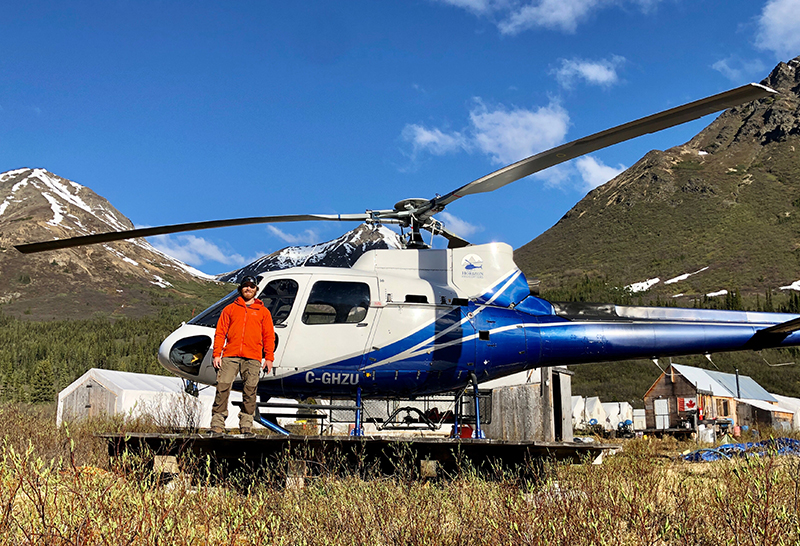 Now a decade into his career as a helicopter pilot, Ammon Hoefs is enjoying the variety and adventure the job brings (Courtesy, Ammon Hoefs).
The only downside is it's pretty much the opposite of a 9-5 Monday-Friday career.
"The job is exciting, it's variable and you learn a lot, but it's a really hard one to strike that work-life balance," said Hoefs.
"Even this morning, I didn't know I was doing this job until about an hour before it. Today is easy because it's a three or four-hour job, but there was one time where I was just supposed to swap a helicopter with another one that needed maintenance. It was supposed to be a three-hour round-trip – fly up an hour, spend an hour on the ground, swapping gear and fly back. I was gone for 17 days. I didn't have a toothbrush or change of underpants. That's how this goes sometimes.
"It's exciting and fun, it's always changing, but it's more of a young person's game," he added. "You can make plans, but you have no idea if you're going to be able to fulfill them because on the day you're supposed to do something, you might not be there.
"But if you can figure out how to balance that and you have an understanding and supportive partner – that's critical – it's an awesome job."


